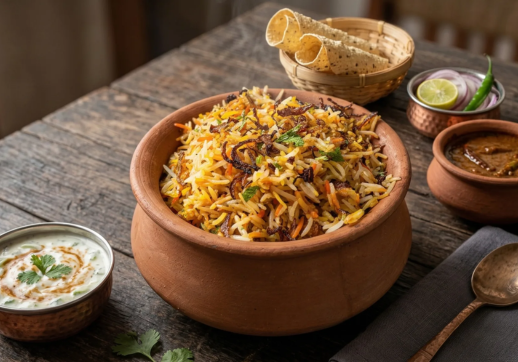
The famous Hyderabadi Biryani irrevocably transports your mind to a distinctive world of taste. One lifted lid, one curl of saffron-scented steam rising from a sealed handi, all these brings you closer to a dish that has taken centuries to perfect. It is not fast food dressed in spice, rather an architecture that needs careful curation. This is history compressed into rice and meat, layered with the ambitions of emperors, the ingenuity of royal cooks, and the accumulated wisdom of a city that has understood eating well as a form of civilization. In fact, authentic Hyderabadi biryani originated in kitchen of Nizams, inculcated Mughal grandeur, and involves ultimate patience.
Hyderabad and Its Historic Biryani
To understand the biryani, you must first understand the city of Nawabs – Hyderabad. It was founded in 1591 by Muhammad Quli Qutb Shah, the fifth sultan of the Qutb Shahi dynasty, on the banks of the Musi River. From its earliest days, the city was designed as a place of beauty, learning, commerce, and culture that would rival the great cities of the Islamic world. The Qutb Shahis were Shia Muslims with Persian cultural sympathies, and their court attracted poets, architects, scholars, and cooks from Persia, Central Asia, and across the Deccan.
Food at the Qutb Shahi court was taken seriously considered an art form. Persian culinary traditions were characterized by the use of dried fruits, saffron, rosewater, and the layering of rice with meat. These traditions were blended with local Deccan ingredients and techniques. It was in this creative, cosmopolitan kitchen that the Hyderabadi Biryani history began to take shape. But the dish reached its full flowering under a different dynasty. In 1724, Nizam-ul-Mulk Asaf Jah I broke away from the declining Mughal Empire and established the Asaf Jahi dynasty — the Nizams of Hyderabad.
For the next two centuries, the Nizams ruled Hyderabad as the wealthiest princely state in British India. They, also, transformed the legendary appetite for culture, craftsmanship, and cuisine. The Nizam’s kitchens, called the Matbakh, employed hundreds of specialist cooks as each one of them was responsible to prepare a single dish. The biryani was not merely a meal in Nizam’s kitchen; it was a state-of-the-art production. In fact, the ingredients of Hyderabadi Biryani demanded the finest basmati rice, the tenderest meat, the most fragrant spices, and the touch of highly skilled hands. It was under the Nizams that Hyderabadi Biryani became the precise, codified, magnificent thing it is today.
The Dum: A Technique That Changed Everything
At the heart of famous Hyderabadi Biryani lies a cooking technique called dum, which has been identified as a Persian word meaning breath or steam. In this method, partially cooked rice and marinated meat are layered together in a heavy-bottomed vessel. After this, the lid is sealed with a ring of dough to trap steam completely. Later, the whole assembly is placed over a low flame, and left to cook in its own fragrant atmosphere for an extended period. The result of this slow, sealed cooking is something that no other method produces. It perfectly looks the rice with stains of saffron, and tenders the meat in such a way that produces delectable aroma of Hyderabadi Biryani.
Every portion, when served, highlights the spectacular cooking journey. The saffron-kissed rice at the top, the caramelized onions and herbs in the middle, and the richly flavoured meat at the base, explicates the finest culinary architecture. Watching a skilled biryani chef unseal a Dum Handi is one of the great theatrical moments because the dough crust cracks open. As the dough is separated, the fragrance of saffron, cardamom, clove, fried onion, and roasted meat take you back to the Nizam’s kitchen.
Kacchi vs. Pakki: The Great Debate
Within Hyderabadi Biryani itself, there exists a fundamental division that aficionados regard with great seriousness. It is the difference between kacchi and pakki preparations.
Kacchi Biryani
Identified as the more complex and celebrated of the two, it involves layering raw, marinated meat directly beneath the parboiled rice and cooking everything together in the Dum Handi. The meat releases its juices slowly as it cooks, flavouring the rice from below while being simultaneously steamed from above. This method requires precise timing, deep experience, and unwavering attention. The reason is that if the flame is too high, the meat scorches, and on being too low, the rice fails to cook properly. When it is done correctly, Kacchi biryani is widely considered as one of the most technically demanding dishes in the Indian cooking.
Pakki Biryani
It takes a more forgiving route, where the meat is cooked separately in its gravy before being layered with the parboiled rice for the final Dum. The results are still excellent as the aroma of Hyderabadi Biryani is rich and deeply flavoured. But, the integration of rice and meat is considered less seamless than in the Kacchi method. Most restaurants, given the logistical challenges of cooking Kacchi to order, serve Pakki Biryani.
Aromatic Components of Hyderabadi Biryani
The ingredient list of an authentic Hyderabadi Biryani reads like a journey on the spice routes, connecting the subcontinent to Persia, Arabia, and the Mediterranean. Whole spices like green cardamom, black cardamom, cinnamon, cloves, bay leaves, star anise, mace, are layered through the dish at different stages. Each one of them releases its special character at a different temperature and moment in the cooking process.
The marinade for the meat typically includes yoghurt, ginger-garlic paste, raw papaya, red chilli, turmeric, and a blend of ground spices that varies by household and restaurant. Fried onions, called barista, are perhaps the most underappreciated component. It is thinly sliced, slowly fried to a deep mahogany color. Certainly, their sweetness and crunch provide the essential counterpoint to the richness of the meat below. Apart from these exotic ingredients of Hyderabadi Biryani, Saffron is used after dissolving in warm milk and drizzled over the top layer of rice before sealing.
Fresh mint and coriander is scattered between the layers to add a cool green note that cuts through the richness at unexpected intervals. The genius of Hyderabadi Biryani is not that it is spicy, but the layering technique. Every bite is slightly different from the last, offering a new combination from its many other ingredients.
Today, authentic Hyderabadi Biryani is arguably the most recognizable regional dish in India, served in restaurants throughout the world. Wherever a large pot of saffron-scented rice is sealed and placed over a slow flame, the old Nizam’s kitchens are in some sense still operating. But the best version that closes the gap between the dish and its full meaning, is still the one eaten in the old city, from a steel plate, with raita and mirchi ka salan on the side.